I’m well aware of the phenomenon of “filing off the serial numbers” in fan fiction. (It’s pretty much impossible for any fan fiction author not to know about it, particularly in the wake of Fifty Shades of Grey.) To be quite honest, filed-off fan fiction tends not to be very good, and I often find myself turned off a bit by it. After all, one of the unspoken rules of fan fiction is that it’s always kept non-commercial; the very act of filing off the serial numbers violates that rule.
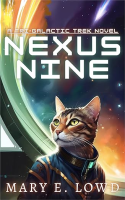
Available through Amazon and many other retailers
But I’ll admit it: every time I saw an advertisement for Mary E. Lowd’s Nexus Nine: a Tri-Galactic Trek Novel, it looked interesting. And recently, when I had some digital credits over at Amazon, I gave in and purchased it.
I’m not sorry. Not at all. Rather the reverse: I adored it.
The author doesn’t even try to hide that this is an “affectionate fan fiction” of Star Trek: Deep Space Nine. But, as someone who’s both a fan of DS9 and a fan fiction author myself, I was able to spot why this particular book is being sold legitimately — and legally. The background universe, while being obviously Trek-derived, contains original elements (as examples, its origin mythology and the historical position of cats vs. dogs). The main character, one Mazel Rheun, has aspects that were not present in either iteration of the original. The “nine” associated with the nexus’ name comes isn’t derived from the show.
Not to mention that the plot is nearly 100% original.
There are some superficial similarities to DS9, but superficial is all they are. Mazel Rheun’s connection to the other side of the nexus — a major driver of the action — has no equivalent; and the idea behind separating Mazel and Rheun is presented completely differently from the way it was in the show, with its own unique impacts and ramifications. It’s different enough that I’m not even sure this book still qualifies as fan fiction.
Make no mistake: there are differences, and this isn’t high-quality literature. I found many of the other characterizations, aside of Mazel herself, to be pretty thin; and the plot was fairly straightforward — it doesn’t have the complexity of a full-length novel even if it technically qualifies based on its word count. That said, I never got the impression that this was what the author had set out to do, and the lack of depth made it a much easier and faster read.
I got through Nexus Nine in about two hours, which was exactly the right amount of time to devote to something intended as light, entertaining reading. I enjoyed it. I’ll be checking out more of Mary Lowd’s work. And I really hope that, someday, I’ll get to see Mazel Rheun again in another story.